
Radon in East Tennessee: Why Testing Your Home Matters
Radon in East Tennessee: Why Testing Your Home Matters
There is an invisible, odorless gas that may be seeping into your home right now. You cannot see it, smell it, or taste it, but prolonged exposure to it is the second leading cause of lung cancer in the United States, responsible for an estimated 21,000 deaths every year. That gas is radon, and East Tennessee is one of the highest-risk regions in the entire country.
If you are buying a home in Knoxville, Maryville, Oak Ridge, Lenoir City, or anywhere in the surrounding counties, radon testing is not just a good idea — it is essential. Here is everything you need to know about radon in our region and why testing your home could be one of the most important decisions you make.
What Is Radon?
Radon is a naturally occurring radioactive gas produced by the decay of uranium in soil, rock, and water. It is present virtually everywhere at low levels, but it becomes a health concern when it accumulates inside enclosed spaces like homes. Radon enters through cracks in foundations, gaps around pipes, sump pump openings, crawl spaces, and any other pathway from the ground into the living space.
Once inside, radon gas breaks down into radioactive particles that can become trapped in your lungs when you breathe. Over time, these particles damage lung tissue and can lead to lung cancer. The risk increases with higher concentrations and longer exposure. According to the Environmental Protection Agency (EPA), there is no known safe level of radon exposure.
Why East Tennessee Is a High-Risk Area
The EPA classifies counties into three zones based on predicted average indoor radon levels. Zone 1 is the highest risk category, with predicted average levels above 4.0 picocuries per liter (pCi/L) — the EPA’s action level. Virtually every county in the East Tennessee service area falls into EPA Zone 1:
- Knox County — Zone 1
- Loudon County — Zone 1
- Blount County — Zone 1
- Anderson County — Zone 1
- Roane County — Zone 1
- Monroe County — Zone 1
- McMinn County — Zone 1
- Hamblen County — Zone 1
The reason for these elevated levels lies beneath our feet. East Tennessee sits on the Chattanooga Shale formation, a layer of uranium-rich black shale that stretches across much of the Tennessee Valley. This geological formation is one of the most significant natural sources of radon in the southeastern United States. As the uranium in the shale decays, it produces radon gas that migrates upward through the soil and into homes above.
The combination of this geology with the prevalence of crawl space foundations in our region creates ideal conditions for radon accumulation. Approximately 30 percent of homes tested in East Tennessee have radon levels at or above the EPA’s action level of 4.0 pCi/L. Some homes test far higher — I have personally seen readings above 20 pCi/L in properties right here in Knox County.
The Health Risks Are Real
Radon is the second leading cause of lung cancer after smoking, according to both the EPA and the American Lung Association. For non-smokers, radon is the number one cause of lung cancer. The risk is not theoretical or distant — it is a well-documented, scientifically established health hazard.
Here is what makes radon particularly dangerous:
- There are no immediate symptoms. Unlike carbon monoxide, which can cause headaches and nausea, radon exposure produces no short-term warning signs. The damage accumulates silently over years.
- Any home can have elevated levels. It does not matter if your neighbor’s home tested low. Radon levels can vary dramatically from one property to the next, even on the same street. Soil conditions, foundation type, and construction details all play a role.
- New homes are not immune. Modern construction does not prevent radon entry. In fact, tighter building envelopes can sometimes trap radon more effectively than older, draftier homes.
The EPA estimates that the risk of lung cancer from living in a home with a radon level of 4.0 pCi/L is roughly equivalent to smoking half a pack of cigarettes per day. At 8.0 pCi/L, the risk is comparable to smoking a full pack daily.
How Radon Testing Works
Radon testing is straightforward, non-invasive, and affordable. There are two main types of tests:
Short-Term Testing
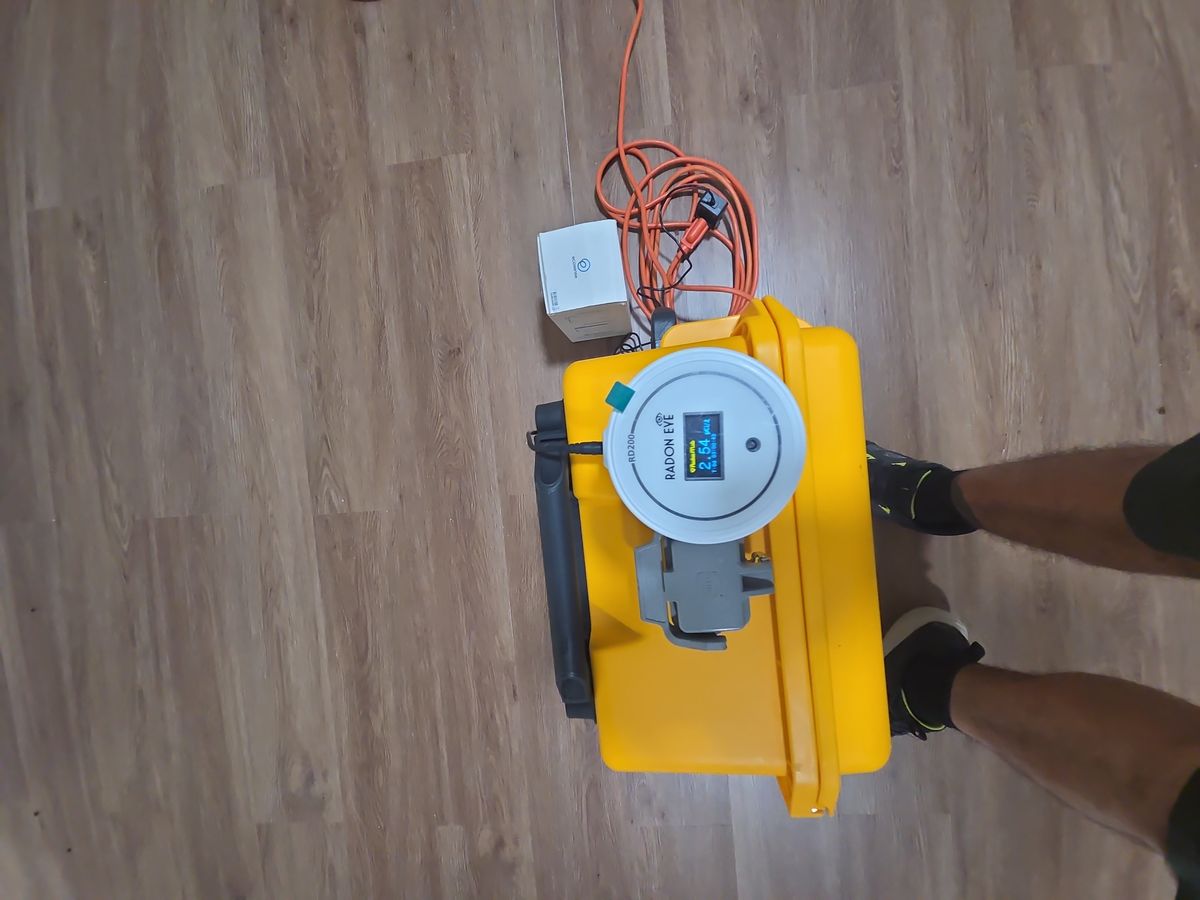
A short-term radon test typically runs for 48 to 96 hours. During a home inspection, I deploy continuous radon monitors (CRMs) that take hourly readings throughout the testing period. These professional-grade devices provide accurate, tamper-evident results and are far more reliable than the charcoal canister kits available at hardware stores.
The monitors are placed in the lowest livable area of the home — typically the basement or main floor if the home is built on a crawl space. During testing, windows and exterior doors should remain closed as much as possible (normal entry and exit is fine), and the home’s HVAC system should operate normally.
Long-Term Testing
Long-term tests run for 90 days or more and provide a more accurate picture of the home’s average radon level across different seasons and weather conditions. While long-term tests give the most reliable data, they are not practical during a real estate transaction. That is why the short-term CRM test is the standard for home inspections.
Interpreting the Results
The EPA has established 4.0 pCi/L as the action level — the concentration at which they recommend taking steps to reduce radon. However, the EPA also states that any radon level carries some risk, and homeowners should consider mitigation for levels between 2.0 and 4.0 pCi/L as well.
- Below 2.0 pCi/L — Low risk. No action required, but retesting every few years is a good practice.
- 2.0 to 3.9 pCi/L — Moderate risk. Consider mitigation, especially if you plan to live in the home long-term.
- 4.0 pCi/L and above — Action recommended. Mitigation should be installed.
Radon Mitigation: What It Involves and What It Costs
If testing reveals elevated radon levels, the good news is that mitigation is effective, well-established, and relatively affordable. The most common mitigation method is called sub-slab depressurization (or sub-membrane depressurization for crawl space homes). Here is how it works:
- A suction point is created beneath the foundation slab or crawl space vapor barrier.
- PVC piping runs from the suction point up through the home and out above the roofline.
- A radon fan mounted on the pipe creates negative pressure beneath the foundation, pulling radon gas from under the home and venting it safely above the roof where it disperses harmlessly into the outdoor air.
The system runs continuously, uses minimal electricity (comparable to a light bulb), and is virtually silent. Once installed, it is maintenance-free aside from periodic fan checks.
Mitigation Costs
In the East Tennessee market, professional radon mitigation typically costs approximately $800 to $2,500, with most installations coming in around $1,500 to $2,000. The cost depends on factors like:
- Foundation type (slab, crawl space, or combination)
- Size of the home
- Accessibility of the foundation
- Number of suction points needed
- Aesthetic considerations for pipe routing
For a health hazard of this magnitude, mitigation is remarkably cost-effective. Many buyers in the Knoxville area negotiate radon mitigation into the purchase agreement, having the seller either install a system or provide a credit at closing.
Radon and Real Estate Transactions
Radon testing has become a standard part of the home buying process in East Tennessee, and for good reason. Here is how it typically fits into a transaction:
- During the inspection period, a radon test is conducted alongside the general home inspection.
- If levels are elevated, the buyer can request that the seller install a mitigation system prior to closing, provide a financial credit for mitigation, or reduce the purchase price accordingly.
- Most sellers in our area are willing to address radon findings because they understand it is a well-known regional issue and an inexpensive fix relative to the home’s value.
If you are selling a home, consider having radon testing done as part of a pre-listing inspection. Knowing your levels — and having a mitigation system already installed if needed — removes a potential obstacle from the sale and demonstrates good faith to buyers.
Common Misconceptions About Radon
”My neighbor’s home tested fine, so mine should be too.”
Radon levels can vary significantly between adjacent properties. Underground geology, soil permeability, and construction details all affect how much radon enters a specific home. The only way to know your home’s radon level is to test it.
”I live on a hilltop, so radon is not a concern.”
Elevation has little bearing on radon levels. The Chattanooga Shale formation underlies valleys and ridges alike across East Tennessee. Homes at every elevation can have elevated radon.
”My home has a crawl space, so radon can ventilate out.”
While crawl spaces can provide some natural ventilation, radon often still accumulates in the living space above. Warm air rising inside the home creates a stack effect that draws soil gases — including radon — upward through the floor system.
”Radon is only a problem in winter.”
Radon levels do tend to be higher in winter when homes are closed up, but elevated levels can occur in any season. The Chattanooga Shale produces radon year-round.
”Testing is expensive and complicated.”
Professional radon testing during a home inspection typically costs between $150 and $200 in the Knoxville area. It requires no preparation on your part and produces results in 48 to 96 hours.
Protecting Your Family
Radon is a serious health risk, but it is also an entirely manageable one. Testing is affordable, results are clear, and mitigation is effective. The only unacceptable approach is not testing at all.
With 30 percent of East Tennessee homes testing above the EPA action level, the odds are meaningful. Whether you are buying a home in West Knoxville, settling in Lenoir City, or looking at property in Oak Ridge, radon testing should be a non-negotiable part of your due diligence.
Schedule Your Radon Test Today
As an InterNACHI Trained home inspector serving Knox, Loudon, Blount, Anderson, Roane, Monroe, McMinn, and Hamblen counties, I include radon testing as an add-on service with every home inspection. My professional-grade continuous radon monitors provide accurate, detailed results that hold up in real estate negotiations.
Use our online quote calculator to get an estimate that includes radon testing, or call me directly at (865) 816-4084. When it comes to radon in East Tennessee, what you do not know absolutely can hurt you. Let’s make sure you have the information you need to protect your family.
Ready to Schedule Your Inspection?
Get an instant quote and book online, or call Steven directly.